

MemChurch Prison Ministry: Lessons Beyond the Walls
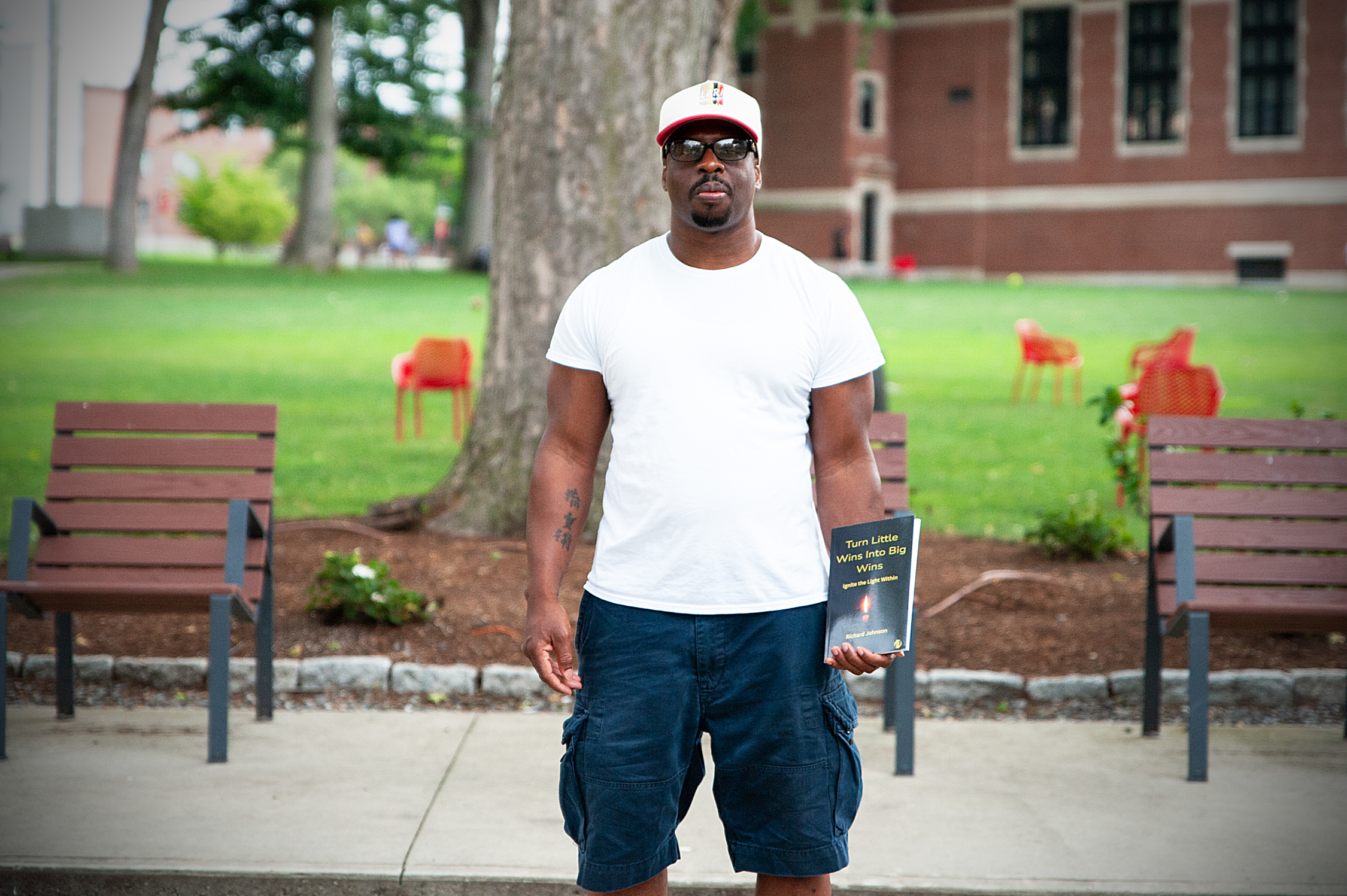
Richard Johnson holds a copy of his book, Turn Little Wins Into Big Wins: Ignite the Light Within You, at Clark University in Worcester. Johnson is a student in Clark University's Liberal Arts for Returning Citizens program. Photos by Jeffrey Blackwell.
By Jeffrey Blackwell
Memorial Church Communications
The Massachusetts Correctional Institution at Shirley is a medium-security prison located north of Worcester, housing over a thousand inmates. It’s an imposing facility, with institutional-style cell blocks enclosed by tall fences topped with razor wire.
The facility is designed to confine people within its walls and fences. Armed guards, numerous locked doors, and a comprehensive rulebook oversee every movement inside and every interaction outside. Yet in this environment, Megumi Abe and other volunteer mentors from the Memorial Church hope to help those society often overlooks, including 26-year-old mentee Carlos, who has served more than five years of a long prison sentence.
"I think, for me, I've just been so impressed with his resilience and his ability to approach a terrible situation with so much grace and optimism, and to really try to make the most of everything that comes his way,” said Abe, a congregant who works for a non-profit in Connecticut. “I think that's really made a big impression on me. And I think it’s given me a deeper, more personal understanding of the injustice of the system."
The Memorial Church takes part in two programs that mentor or educate people who were recently released or are currently incarcerated in the state prison system. The Rev. Matthew Ichihashi Potts, Plummer Professor of Christian Morals in the Faculty of Divinity and Pusey Minister in the church, volunteers as a teacher in the Liberal Arts for Returning Citizens program at Clark University in Worcester. Additionally, church volunteers, including Potts and Abe, also participate in Partakers, a program that pairs mentors with inmates seeking college degrees while in prison.
For Potts, the drive to volunteer was always part of his life. He began working in the prison system early in his Harvard career, before his appointment at the Memorial Church, when a group of Divinity School students formed teams to provide mentorship through Partakers.
“I was interested in working with people who were in prison, and maybe the deeper question is, why?” he said. “I think the most straightforward practical answer is that, in the gospels, Jesus says to visit the prisoner. Then, as I was thinking about what I wanted to do with my work on forgiveness, including its practical, pastoral, and political applicability, I thought I should invite the church into that work in a broader way.”
After his 2021 appointment, Potts called on members of the Memorial Church congregation to volunteer for the mentorship program, primarily to reach those incarcerated in the state prison system following the pandemic.
Partakers aims to reduce prison recidivism by mentoring inmates in Massachusetts who are pursuing bachelor’s degrees while incarcerated. Jeannette Hanlon, a social worker in the prison system, founded the organization in 1997 after mentoring a man seeking his degree. That man, Arthur Bembury, is now the organization's executive director.
“Partakers connects community mentors, people like you and me, with students earning a college degree while incarcerated," said Melanie MacFarlane, Interim Director of Tufts University Prison Initiative of Tisch College, and a former volunteer coordinator for Partakers. "Each student gets four mentors, and that team becomes a unit of consistency for students, who get visits, letters, encouragement, and support in their college journey. Most students are the first in their family to attend college, so the mentors make a big difference.”
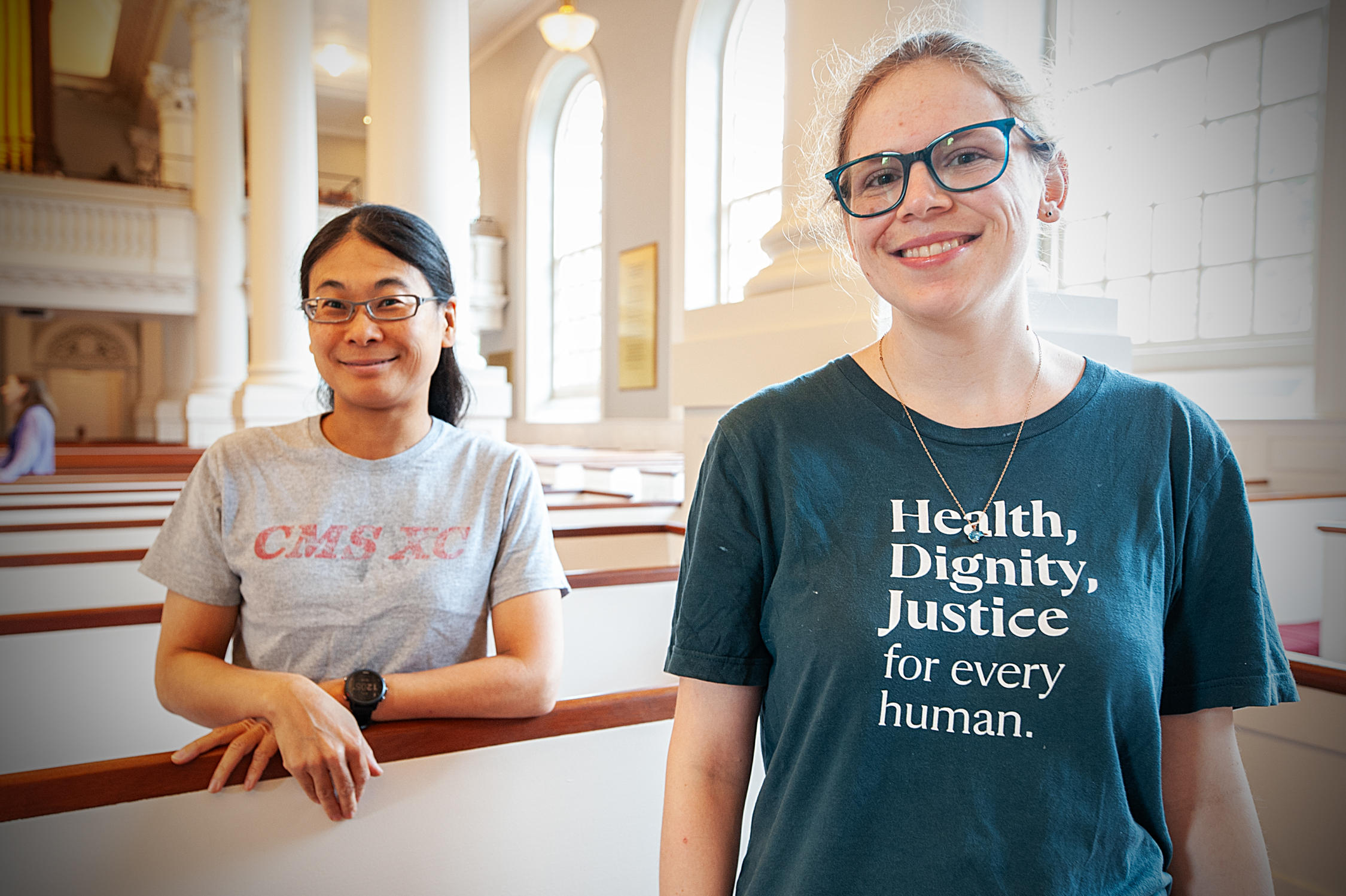
Merryn Fraser (front right) and Megumi Abe, congregants and volunteers with Partakers.
Over the past three years, two teams from the Memorial Church have participated in the program. The current team, which includes Potts, Abe, and Merryn Fraser, visits the Massachusetts Correctional Institution at Shirley to meet with Carlos about once a month.
Visits to the prison in Shirley are intended to be two-way discussions about the student’s classes, projects, and research materials needed for papers and presentations, because the inmate has limited internet access. The relationship also gives students a window into the outside world.
Merryn Fraser is a Postdoctoral Fellow in Immunology and Infectious Diseases at the Harvard T.H. Chan School of Public Health and a regular MemChurch congregant. She said she is always seeking volunteer opportunities that make a real-world impact.
“The first time, it's definitely an intimidating experience to walk up to that building,” Fraser said. “It really does get you to challenge your own assumptions and implicit biases, or the way that you've been conditioned to think about people in these situations. And this is part of why I say we learn more than we can teach our students, because it really gets us to think about the reality of the legal or criminal justice system, to challenge our own assumptions, and to share that information with others.”
Before each session, mentors must complete a thorough check-in process and adhere to a strict two-page dress code. Volunteers are encouraged to bring an extra set of clothes in case their initial outfit does not comply with the code. Sessions, often lasting several hours, take place in a spacious room with chairs arranged face-to-face to make conversations between inmates and visitors easier.
“We try to help and provide advice if any issues come up in any academic areas. And then we celebrate it with them, on anything they're excited about or want to tell us about,” said Abe. “I think our team has really let Carlos take the lead on the topics he wants to discuss. He's a very inquisitive person, so he has a lot of questions for us. Many of them have been very philosophical in nature, and they tend to lead to really interesting conversations about life, our perspectives, current events, politics, and philosophy. It just goes in a lot of different directions.”
In addition to the Partakers program, Rev. Potts also teaches in a program that offers college-level liberal arts courses through Clark University for people formerly incarcerated seeking to start or continue their education.
Shelly Tenenbaum is a professor of Sociology at Clark University and directs the Liberal Arts for Returning Citizens (LARC) program, which she helped launch in 2022, after teaching in prison programs through Boston and Emerson universities.
The program offers a range of classes including art, music, history, sociology, political science, anthropology, economics, and chemistry. It also offers courses in financial literacy, AI, and digital literacy. Potts teaches classes in religion and ethics.
“It's a tuition-free college program for people who have been out of prison,” said Tenenbaum. “Our students need those foundational academic and life skills. We have people who got out of prison after 25 years. They’ve never seen a smartphone.”
LARC is not a degree program, but it awards college credit that can transfer to a degree program. It is free for eligible students, who also receive university IDs and access to campus resources including the Writing Center and Goddard Library.
“I want to offer classes directly related to employment. I want to offer classes directly related to those foundational life academic skills,” Tenenbaum said. “It's about those light bulb moments. It's about thinking about one's own identity, and where one fits in the world.”
Richard Johnson served four years at Old Colony Correctional, North Correctional Center, and Pondville Correctional Center on drug-related charges before entering the LARC program upon his release. He says his life has transformed from drug dealer to author, real estate professional, family man, and man of God.
“The same way I funneled all my energy into being a prolific drug dealer, now I funnel my energy into doing something that is positive,” Johnson said. “Instead of pumping the community with poison for profit, now I want to fuel the world with creativity, with my knowledge and what I think is entertaining through my writing.”
Johnson has published two books since his release: Turn Little Wins Into Big Wins: Ignite the Light Within You and a murder mystery titled Deathbed Dreams. He wrote them while incarcerated and served as a librarian in the prison library.
The LARC program has opened doors for him that would otherwise have remained closed because of his criminal record. Through his connection with the program and Tenenbaum, he earned a biomanufacturing certification from Worcester Polytechnic and secured an internship at Teragen Energy. Johnson is also working toward his real estate license.
“LARC gave me the confidence that I knew how to study and that I could do it,” Johnson said. “Because I have all these outstanding people behind me, including Professors Tenenbaum and Potts, I had a massive number of references. I was able to use that, and they terminated my probation early. I would say that Professor Potts has been exceptional and that Professor Shelly Tenenbaum is a Godsend.”

The Rev. Matthew Ichihashi Potts, Plummer Professor of Christian Morals in the Faculty of Divinity and Pusey Minister in the Memorial Church.
The lessons from these programs flow both ways. Potts and the other volunteers say that they learn at least as much from their students as they teach them.
“I think we provide some dignity. We're people who show up and speak to them and talk about the work they're doing,” said Potts. “I did take a lot from the experience just in terms of the direction of my research and my writing and my teaching. But I've come to care about these folks, and they feel like they care about me, and that's enough. That is its own reward.”
MacFarlane speaks with local groups, such as the Memorial Church, about Tufts' partnership with Partakers to build awareness of college in prison and inspire prospective mentors. She highlights the importance of the work and the need for a consistent, long-term commitment to provide support and continuity for the student.
“I always qualify by saying that staying out of prison isn't really an educational outcome, but it's the number people remember: 75 percent are back within five years, but if you get a college degree, it drops to less than 5 percent,” said MacFarlane. “When I give a talk, I always bring a student who is now home. They really break down the stereotypes about people who are incarcerated. And we often debate who has more impact because we learn so much from our students."